Restore a vintage camera and post it as an online serial? Why not! For $12 I purchased an elegant old lady of photography, a Model 3A Folding Ansco, and will restore it online, posting the process to illustrate each step. This post will describe the camera and explore its story; Part V will describe the restoration.

The Model 3A Name Plate
The 3A Ansco is an elegant camera, with a wooden body covered with lovely pebble-grained Moroccan leather, and metal parts that gleam (or once gleamed, as they are sadly tarnished) with nickel plating. The front standard supports a big, round, black shutter atop a gleaming collection of struts, levers and extendable feet.

The No. 3A Folding Ansco
The Ansco’s proportions are generous, measuring 9 1/2 x 4 3/4 x 2 in (24 x 12 x 5 cm), and she weights in at 2 lb 8 oz – hardly a “Vest Pocket” model, even allowing for how loosely that term was applied in those days. Her size allows her to use Ansco 18A or 18B film, equivalent to Kodak’s No. 122 film, permitting an expansive 3 1/4 x 5 1/2 in negative and qualifying the 3A a a true “Postcard” camera.
For film she probably used Ansco’s Plenachrome or Super Plenachrome, quality films but with not quite the contrast and image quality of the contemporary Kodak and Agfa films. Scott’s Photographica Collection web page has an excellent discussion of Ansco film sizes.
The Model 3A Folding Ansco was produced from 1914 to 1932. Unfortunately, unlike Kodak cameras, information on Ansco cameras’ production runs and model changes is limited, so dating an individual camera is a challenge. Diligent searching reveals no serial number. The last patent date on the stamping inside the back is 1912, so it is possible that this represents one of the early 1914 models.

Ansco Back Cover Inscription
For a consumer-level camera, the degree of sophistication is a pleasant surprise. The front standard incorporates a moderate degree of rise and fall

Front Rise Mechanism
for architectural subjects, controlled by a lever with click stops to the left of the lens. Lateral shift can be accomplished by unlocking the small handle directly below the lens and sliding the standard left or right on the front runner mechanism. Complex folding legs extend from the front standard to support the camera on a flat surface in vertical and horizontal orientation. A flip-up cover protects and shades the viewfinder, and the mask framing the image on the viewfinder cleverly rotates on a geared mechanism as the viewfinder is rotated from the vertical to the horizontal position. Focusing is
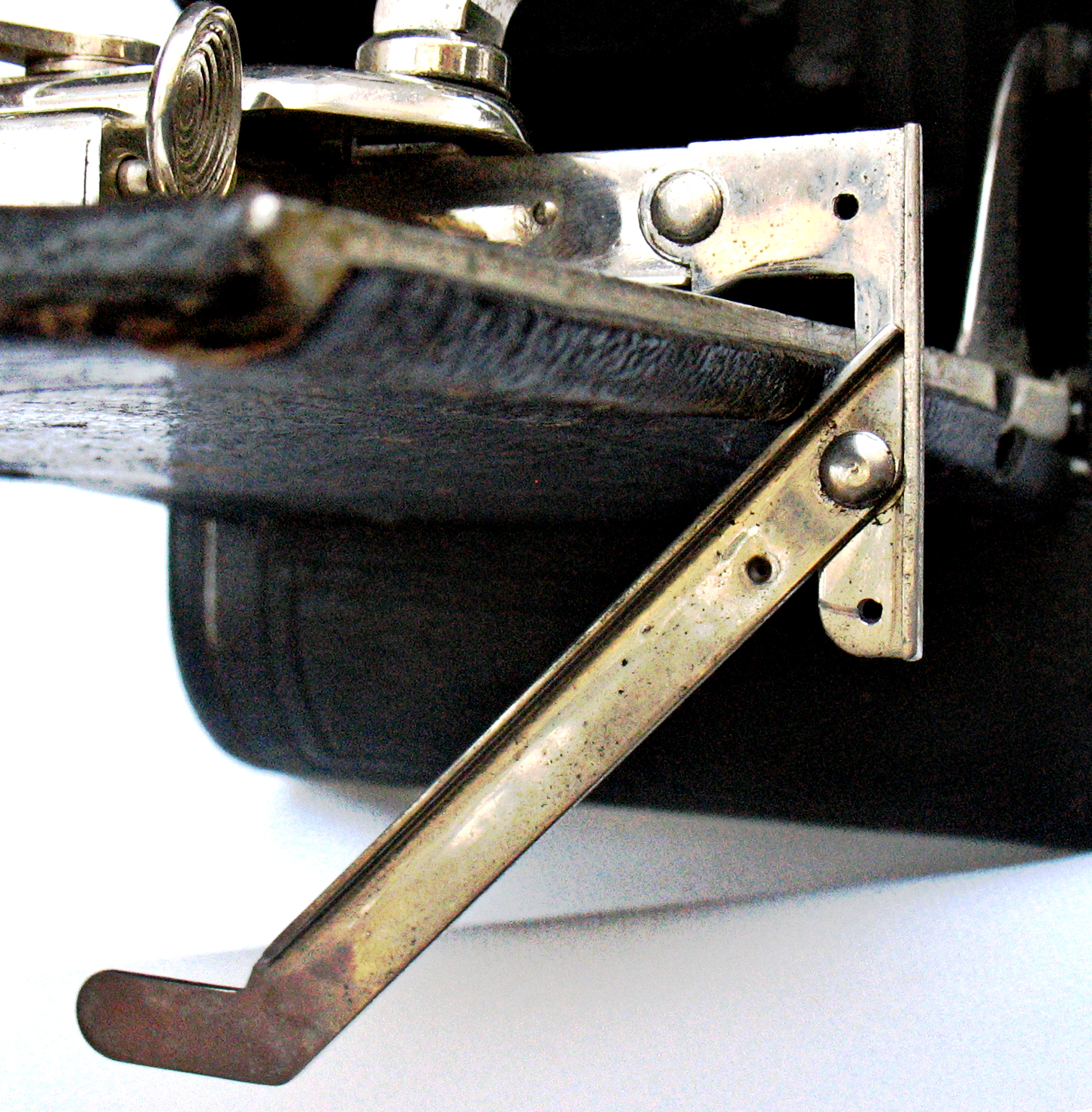
Front Support Foot
accomplished via a lever on the baseplate that is calibrated for both roll film and plates.

Focusing Mechanism
The 3A Ansco had the option to use a back accepting glass plates or film packs; these are found with the camera only rarely.
The Lens and Shutter:
The lens and shutter on this model are more complex than those usually found on a consumer-level camera, the former being an f/6.3 uncoated

Ansco Anastigmat in Acme Shutter
Ansco Anastigmat of 6 3/4 inch focal length. The f-stop scale employs the modern system rather than numerical progression of the U.S. System, suggesting that this might be a later model. The shutter is a dial-set Acme with speeds from 1 to 1/300 second with T and B. The right lever cocks the shutter, while the left is the release. Overall, as received, the shutter is somewhat slow and hesitant, particularly on the slowest speeds.
Acme shutters were a product of Ilex, producer of the well-known Ilex shutters and lenses. Ilex shutters are a notable product of American mass production, being manufactured entirely of stamped rather than machined metal parts. Although they have been compared by some writers to

Ilex Acme Lenses and Ilex Shutters Catalog
two-dollar alarm clocks, they are for the most part solid and reliable, if somewhat less accurate than the more precisely machined Compurs. One should remember that generations of Americans got up and got to work on time thanks to two-dollar clocks and their homely yet reliable mechanisms. Many thousands of these solid little beasts of burden are still in operation today on a variety of lenses.

The Ilex Acme Shutter
It should also be remembered that the purported accuracy of leaf (non-focal plane) shutters is a matter of some complexity and considerable debate. While the more sophisticated shutters (Copal, Compur, and Prontor) can be within a few per cent of the stated value at slower speeds, performance tends to slip with higher speeds, with older shutters in good condition often being 25-50% slower than the nominal values at higher speeds. Ilex shutters are considered to be accurate to within one stop of exposure.
The Ravages of Age:
Like most of us of a certain age, our lady’s complexion has suffered with the years. The front panel/baseplate is studded with small mounds indicating the position of every rivet and screw. A common feature of leather-covered

Copper Oxide Blisters
vintage cameras, these indicate the position of copper oxide blisters formed by the slow oxidation of copper rivets and screws; this process piles up green copper oxide as the rivets oxidize, and may eventually erode entirely through the leather covering. Lifting the leather, much of which has already come loose, reveals these little mounds of green copper oxide over the head of every rivet.

Corroded Rivets
Corrosion is not limited to the rivets; little curls of copper oxide protrude from the base of the focusing rails and patches of corrosion are found on the film winding lever and other brass parts where the plating has worn. Elsewhere, the leather is dry and the glue has failed, leaving parts of the covering hanging.
It should be noted, however, that the Ansco has two characteristics that make it ideal for restoration. First, it it is a truly ratty-looking camera. The leather is dirty and becoming detached , the metal parts are tarnished, the front standard needs polish, and the insides are grimy. Consequently, it was obtained for a modest price. However, the experienced eye will notice that the leather is entirely intact with no tears or missing pieces, the bellows are supple with no corner wear or separation, the lens is clear and without fungus or edge separation, and the camera is structurally completely intact. The Ansco is therefore an excellent candidate for a restoration which, with the exception of a shutter cleaning, should be entirely cosmetic.
The Story:
Every camera has a story, so what do we know about the Ansco? There are some clues. Recent decades are murky, as it was purchased from a used camera dealer on eBay who responded “… I know nothing of its history. I make a market in old photo gear, and this is a cast-off from a friend of mine who buys and collects cameras and typically passes them on to me when he no longer wants them. He had dreams of restoring this one but never got started.”

The Label
One clue to its past is found in an old label glued inside the back plate, showing the owner to be Robert Perrine of Wauwatosa, Wisconsin. It has been 80 or 90 years since this camera was manufactured; one wonders when in this period did he own and use this camera? Given that the advantages of the “postcard” format had largely been eliminated by the mid-1930s by improved films and the ready availability of enlargement, one might assume that the Ansco would have likely been retired from active service after the1930s, and that its time of active use would have been sometime between 1920 and 1940.
These were historic years- from the Roaring 20s to the Great Depression.

Wauwatosa, Wisconsin
A town of 5,800 in 1920, Wauwatosa grew rapidly in the lush glacial farmland of the Menomonee River Valley, just a short train ride west of

Police Raid a Still
downtown Milwaukee. It was the Roaring Twenties, jazz was king in the big cities, and Prohibition was in full swing. Despite Prohibition’s negative effects on Milwaukee’s breweries (the larger breweries were able to stay open by producing near beer or other products such as soda, cheese, candy bars and even snow plows), the area prospered. By the end of the decade, Wauwatosa’s population had nearly quadrupled to 21,000- then came the Great Depression.
There is little specific information on the Depression’s effect on Wauwatosa, but one can infer the impact from events in the Greater Milwaukee area. The

1930s Milwaukee Homeless Community
Milwaukee area’s economy remained strong until 1932, when the Milwaukee Miracle” ended and two-thirds of the wage earners lost their jobs. Poverty became rampant as families lost their homes and went hungry. As bleak as the thirties were for Milwaukee, its municipal government shone during the Depression. The city started its own work relief programs as well as made creative use of the money it was getting from the federal government. However, despite Milwaukee’s successes, the Depression was a miserable time for most Americans, and many farmers lost their land as their farms were repossessed. Many small farms in Wisconsin were abandoned, and their owners moved to the cities. How many images of these times passed through our camera’s lens?
Next, what can we discover about Robert Perrine? For anything genealogical, I’d usually suggest that you see this page. But there is really only one group of people to consult for this case: The Church of Jesus Christ of the Latter Day Saints, i.e., the Mormons. The church’s genealogical library in Salt Lake City is the world’s premier repository of family history data. Consulting their web site at FamilySearch.org reveals over the time period 1900 – 1970 in Wisconsin only one Robert O. Perrine, who was born Sept 15, 1906 and passed away Nov 27, 1992 in the town of Brown Deer. Like Wauwatosa, Brown Deer is a suburb of Milwaukee, suggesting that Mr. Perrine spent most of his life in the Milwaukee area.
However, the mystery deepens. A kind reader, Dean Sturgis, notes that the zip code system was not instituted until 1963, indicating that the label must have been pasted into the Ansco after that time. It is unclear when Ansco stopped making film, but Kodak 122 film, first manufactured in 1903, was taken out of production in April of 1971, so it would have been impractical to use the Ansco after the mid-70s, when film stocks would have run out and labs would have stopped processing larger film sizes.
Kind research by the volunteers at the Wauwatosa Historical Society showed no evidence of a Robert Perrine in the Wauwatosa City Directory for 1932, but by 1936, electrical engineer Robert O. Perrine appeared at 1743 North 73rd Street, together with his wife, Edna Perrine. By 1939, Robert and Edna had moved to 2571 North 81st Street. In 1964, Robert and Edna were still on 81st Street, but Robert had taken a position with the Milwaukee Division of Cutler-Hammer, where he had advanced to the position of department manager. By 1972, Robert had retired, and the couple had been living on 81st Street for over 30 years.
By 1983, Robert and Edna had sold their home and moved to Apartment 318 at 9999 West North Avenue, where they were still living in 1989. As noted above, Robert passed away in November of 1992.
In 1978, Cutler-Hammer was purchased by Eaton Corporation for over $400 million. The company for which Robert worked, now the Milwaukee division of Eaton Cutler-Hammer, is still present on 30th Street in Milwaukee. Unfortunately, inquiries for employee records for Cutler-Hammer from Eaton proved fruitless, and the trail went cold. Still, once again an historic camera took us on a fascinating journey!
Special thanks to Julie Peay, Chair, Research Library and Collections, Wauwatosa Historical Society, and her team of volunteers for their research on the life of Robert O. Perrine.
To be continued…
References:
Bilotta, Scott. “Using Vintage Ansco Roll Film Cameras.” Scott’s Photographica Collection. http://www.vintagephoto.tv/anscofilmtable.shtml.
Church of Jesus Christ of the Latter Day Saints. “Family Search: Robert Perrine.” http://www.familysearch.org/eng/Search/frameset_search.asp
Eaton Corporation Web Site. “Eaton History.” http://www.eaton.com/EatonCom/OurCompany/AboutUs/EatonHistory/.
Grimes, S.K. “Ilex Acme and Universal Shutters.” http://www.skgrimes.com/ilex/index.htm
Kuykendall, Ron. “Ansco Film Numbers and Sizes.” Photographica Digest, Vol XVI, No. 11, Nov. 2009.
Magnum, Walker. “History of odak Roll Film Numbers.” http://www.nwmangum.com/Kodak/FilmHist.html.
“Milwaukee Timeline.” Milwaukee County Historical Society. http://www.milwaukeehistory.net/milwaukee_timeline/1900s.html#Prohibition.
Online Discussion. “LF Shutter Accuracy?” http://www.greenspun.com/bboard/q-and-a-fetch-msg.tcl?msg_id=0065jD
Tomosoy, Tomas. “Restoring Classic and Collectible Cameras.” Amherst Media, Inc.
“Wuawatosa, Wisonsin.” Wikipedia Article. http://en.wikipedia.org/wiki/Wauwatosa,_Wisconsin.
Wauwatosa Historical Society Web Site. http://www.wauwatosahistoricalsociety.org/newresearch_library.htm.
“Zip Codes.” Wikipedia Aricle. http://en.wikipedia.org/wiki/ZIP_code.


